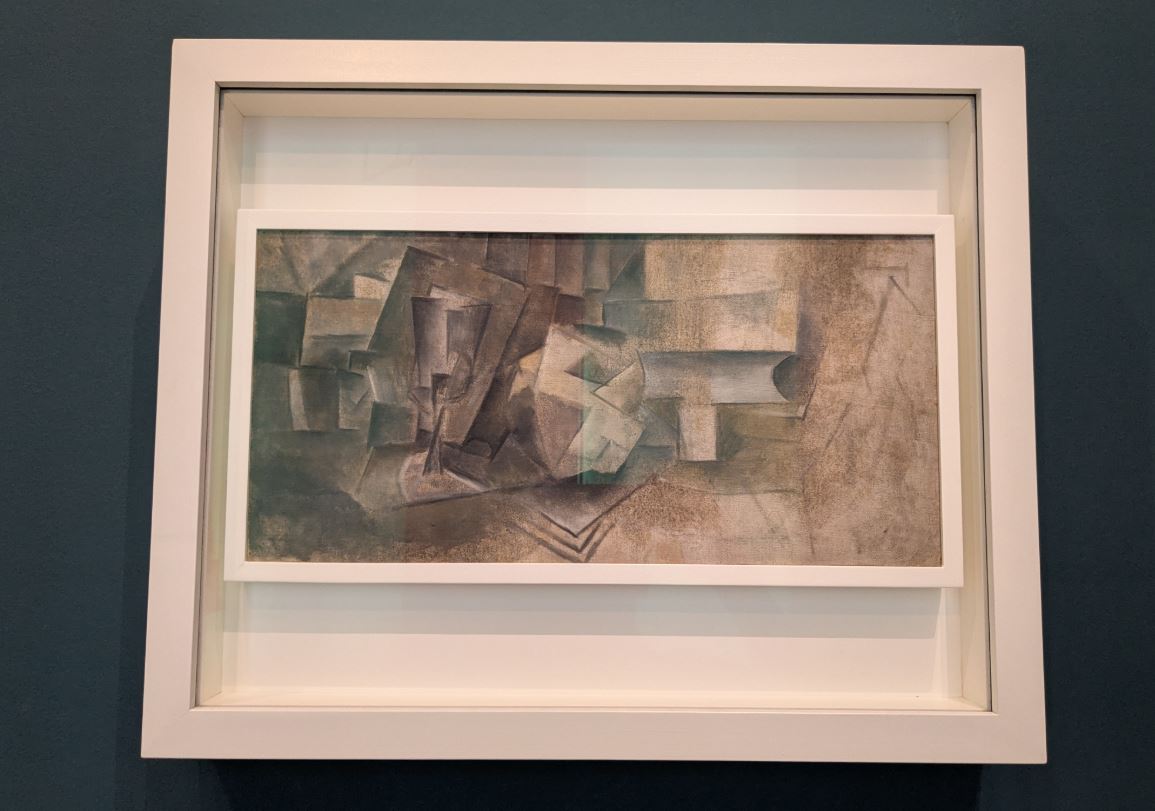
This summer I stood in front of Picasso’s ‘Verre, Pomme, Livres’ (Glass, Apple, Books) and in that moment I saw the cocktail glass! Then the ‘apple’ and all the books – I understood Cubism!
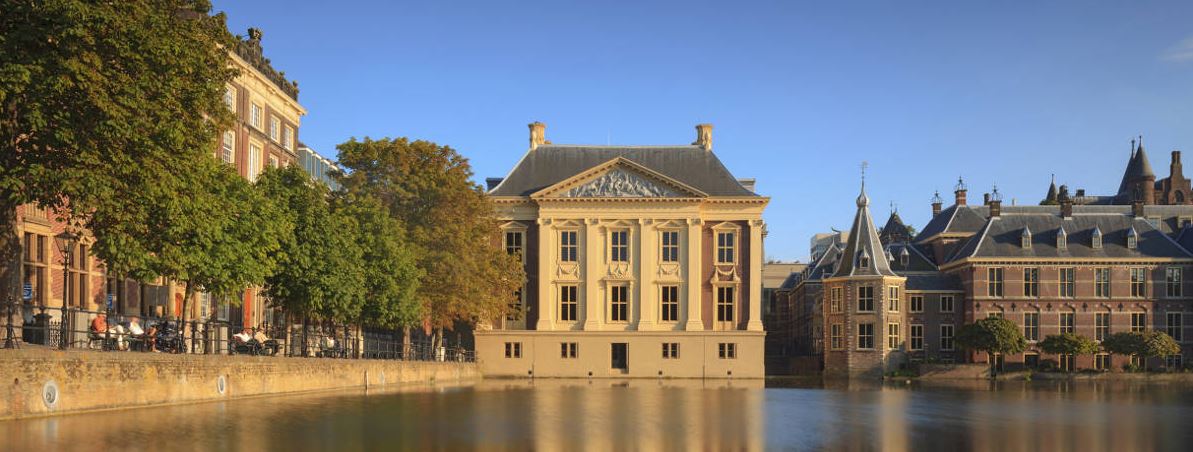
The Musée Picasso is housed in the Hôtel Salé, a stunning 17th-century mansion in the historic Marais district of Paris. This elegant Baroque building is an integral part of your visit; its grand architecture, complete with a magnificent central staircase and ornate ceilings, provides a striking backdrop to Picasso’s modern and experimental art.
Cubism is a revolutionary art movement that emerged in the early 20th century, pioneered by Pablo Picasso and Georges Braque. It challenged traditional art by rejecting a single viewpoint and instead representing objects from multiple angles at once. This created a fractured, two-dimensional composition that emphasized the flatness of the canvas.
Key Principles of Cubism at the Picasso Museum
- Multiple Perspectives: Instead of showing an object as it appears from one fixed position, Cubist artists broke down subjects into geometric shapes and then reassembled them from various viewpoints. This allowed them to show all sides of an object simultaneously.
- Geometric Forms: Objects were simplified and broken down into basic geometric forms, such as cubes, spheres, and cylinders. This technique, often called “fragmentation,” created a complex, interlocking network of planes.
- Emphasis on the Picture Plane: Cubism rejected traditional techniques of illusionistic depth, such as linear perspective and shading (chiaroscuro), which had been dominant since the Renaissance. Instead, the artists highlighted the flat, two-dimensional surface of the canvas.
- Muted Colors: Early Cubist works, particularly those from the “Analytical Cubism” phase (1907-1912), often used a very limited palette of browns, grays, and blacks. This was done to draw the viewer’s attention to the forms and structure rather than the color.
Verre, pomme, livres and Cubism
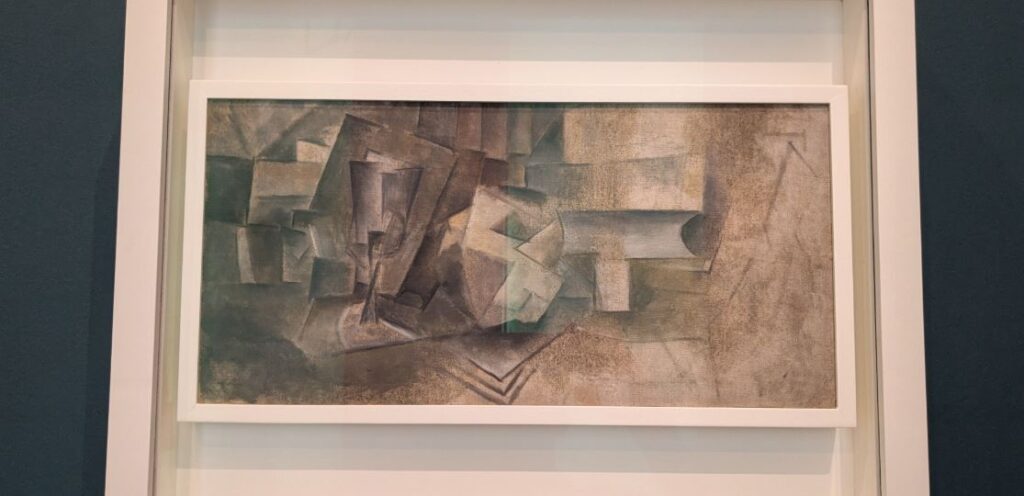
Picasso’s painting Verre, pomme, livres (Glass, Apple, Books) is a great example of Analytical Cubism. In this work, the objects in the still life—the glass, apple, and books—are not easily recognizable as separate, distinct items. Instead, they are broken down into a complex arrangement of overlapping, semi-transparent planes and geometric shapes.
You can see how Picasso has used multiple viewpoints by looking at the glass. It’s not a single, solid object. Instead, its cylindrical form is fragmented and scattered across the canvas, blending into the background. The books and apple are similarly fractured, with their different angles and sides depicted at the same time. This creates a visual puzzle for the viewer, who is forced to engage with the painting and mentally reconstruct the objects. The work’s muted, almost monochromatic color scheme further emphasizes its focus on form and structure, a key characteristic of Analytical Cubism.
You can learn more about how Cubism works by watching this video about cubism.