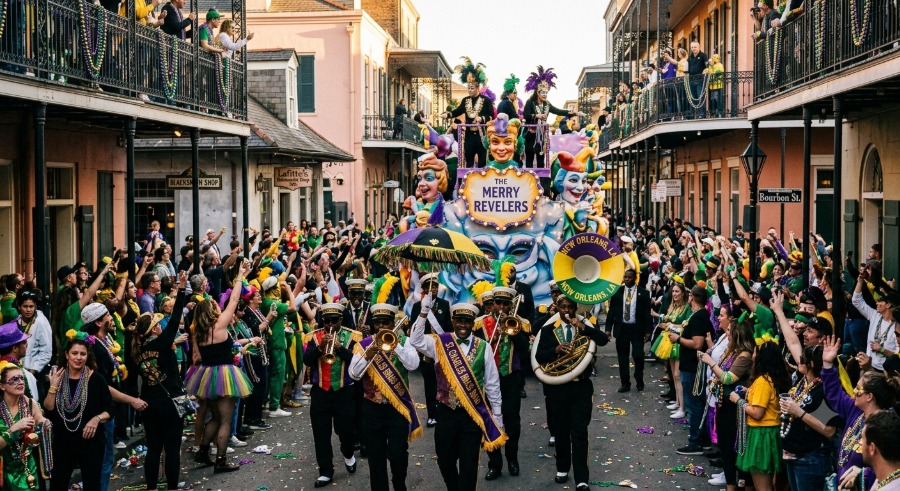
Mardi Gras in New Orleans is not a single party or an isolated Tuesday; it is the explosive culmination of Carnival season—a multi-week tapestry of historic street culture, brass fanfares, and theatrical excess that takes over the city before the austerity of Lent.
Understanding Carnival and the Krewes
Carnival season begins every year on January 6 (Twelfth Night) and rolls through Fat Tuesday (Mardi Gras Day). The celebrations are organized by social clubs known as krewes, each with its own history, traditions, and distinct personality:
- Old-Line Krewes: Organizations like Rex (the King of Carnival) and the Krewe of Proteus preserve the 19th-century traditions that established the official carnival colors: purple for justice, green for faith, and gold for power.
- The Super-Krewes: Massive operations like Endymion, Bacchus, and Orpheus roll on the weekend preceding Fat Tuesday. They feature tandem floats, celebrity monarchs, high-tech light displays, and throws.
- The Zulu Social Aid & Pleasure Club: Founded in the early 20th century by Black New Orleanians, Zulu’s parade on Fat Tuesday morning is famed for throwing hand-painted coconuts—widely considered the most prized throw in Carnival.
- Walking and Satirical Krewes: Smaller clubs like Krewe du Vieux and the Krewe of Barkus weave directly through the narrower streets of the French Quarter and Marigny, focusing on sharp satire, elaborate personal costuming, and brass ensembles.
Anatomy of the Parade Route
Contrary to popular belief, the major float parades do not roll down narrow Bourbon Street. Modern multi-tiered floats require wide boulevards:
- The St. Charles Avenue Corridor: Most major parades originate Uptown and proceed down the oak-shaded neutral ground (median) of St. Charles Avenue before reaching Canal Street. The Uptown stretch is family-friendly, lined with ladders, picnic spreads, and generations of locals.
- The Downtown & Canal Street Stands: As parades cross into the Central Business District, the atmosphere turns higher-energy, with grandstands, commercial viewing areas, and easy access to the French Quarter.
- The Flambeaux Carriers: During night processions, kerosene torches known as flambeaux are carried by dancing torchbearers, continuing an 1850s tradition that once provided the only illumination for night parades.
Cultural Roots Beyond the Floats
- Black Masking Indians: Rooted in the historic solidarity between enslaved Africans and Indigenous communities, tribes like the Creole Wild West spend up to a year hand-sewing elaborate suits covered in thousands of beads, rhinestones, and dyed feathers, squaring off in musical chanting rituals throughout neighborhood backstreets on Mardi Gras Day.
- King Cake Tradition: Between Twelfth Night and Fat Tuesday, bakeries across southern Louisiana produce oval brioche-style pastries topped with purple, green, and gold sugar. Hidden inside is a tiny plastic baby; whoever gets the slice with the baby is crowned king or queen for the day and tasked with buying the next cake.
Practical Guidance for Visitors
- Location Matters: Stay within walking distance of the St. Charles Avenue streetcar line or the French Quarter. Rideshares and taxis face massive street closures and strict vehicle perimeter boundaries.
- Catching Throws: Avoid reaching down onto the pavement with bare fingers for fallen doubloons or beads, as hands can easily be stepped on in dense crowds. Step on the throw with a foot first to claim it cleanly.
- Dress the Part: While float riders are legally required to mask, spectators who dress in full costume or sport the traditional purple, green, and gold are always rewarded with the best throws and warmest interactions from the krewes.