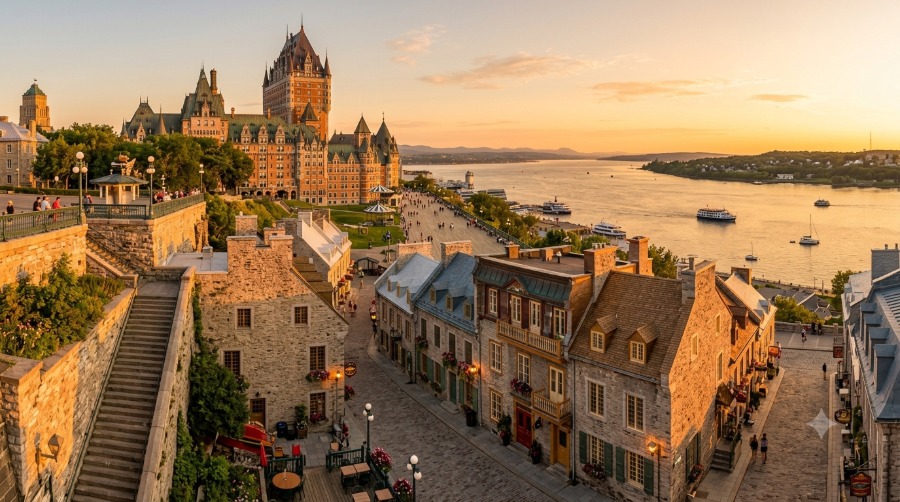
Perched atop the capes overlooking the Saint Lawrence River, Quebec City is the only remaining fortified city north of Mexico, offering 400 years of North American history wrapped in authentic European charm. With its preserved stone ramparts, winding cobblestone streets, and the fairytale silhouette of Château Frontenac towering above the cliffs, Quebec’s provincial capital feels like an old-world enclave brought across the Atlantic.
Historic Highlights & Must-See Sights
- Fairmont Le Château Frontenac & Dufferin Terrace: Holding the title of the world’s most photographed hotel, this 1893 chateau-style landmark dominates the city skyline. Stroll along the wide boardwalk of Dufferin Terrace for sweeping panoramas over the Saint Lawrence River.
- Quartier Petit Champlain & Place Royale: Located in Lower Town (Basse-Ville), this pedestrianized pocket is lined with artisan boutiques, bistro terraces, and 17th-century stone houses. Visit Place Royale, the cobblestone square where Samuel de Champlain founded French North America in 1608.
- The Ramparts & La Citadelle de Québec: Walk the 4.6 kilometers of surviving defensive stone walls and original fortified gates. At Cap Diamant sits the British star-shaped Citadelle, an active military installation and the official residence of Canada’s Governor General.
- The Plains of Abraham: The sprawling urban park where British and French forces clashed in the pivotal 1759 battle. Today, it offers rolling green trails in summer and cross-country skiing in winter.
- Old Quebec Funicular & Breakneck Stairs: Travel between Upper Town (Haute-Ville) and Lower Town via the 1879 electric funicular or walk down the Escalier Casse-Cou (Breakneck Stairs) for framed street views of Petit Champlain.
Beyond the Historic Ramparts
- Saint-Roch & Saint-Jean-Baptiste: Head outside the old walls into the trendy lower-city neighborhoods of Saint-Roch and Saint-Jean-Baptiste for craft microbreweries, indie record stores, and local roasteries along Rue Saint-Joseph.
- Montmorency Falls: Located just 15 minutes north of downtown, these falls plunge 83 meters into the river—towering 30 meters higher than Niagara. Walk across the suspension bridge directly over the crest or ride the cable car across the gorge.
- Île d’Orléans: An agricultural island 15 minutes east of the city, renowned for cideries, maple sugar shacks, blackcurrant vineyards, and preserved ancestral stone farmhouses.
Practical Visit Planner
| Detail | Recommendation |
|---|---|
| Ideal Duration | 2 to 4 days |
| Best Base Areas | Haute-Ville / Old Quebec (historic ambiance, steps from major sights), Saint-Jean-Baptiste / Montcalm (quieter, local cafe culture) |
| Getting Around | Strictly on foot within Old Quebec. Roads are steep, narrow, and often pedestrian-only. Taxis or local RTC buses handle trips out to Montmorency Falls. |
| Language | French is the official language. English is widely understood in hospitality and tourist areas, but simple courtesies (bonjour, merci, s’il vous plaît) are appreciated. |
| Culinary Classics | Traditional tourtière (spiced meat pie), artisan cheeses from Charlevoix, authentic poutine from local diners, and maple taffy rolled on fresh snow in winter. |
Seasonal Travel Tip
Winter turns Old Quebec into an alpine village straight out of a storybook, highlighted by the annual Winter Carnival (Carnaval de Québec) and the nearby ice hotel (Hôtel de Glace). If visiting between December and March, pack thermal base layers, wool socks, and windproof outer shells for the stiff St. Lawrence winds.