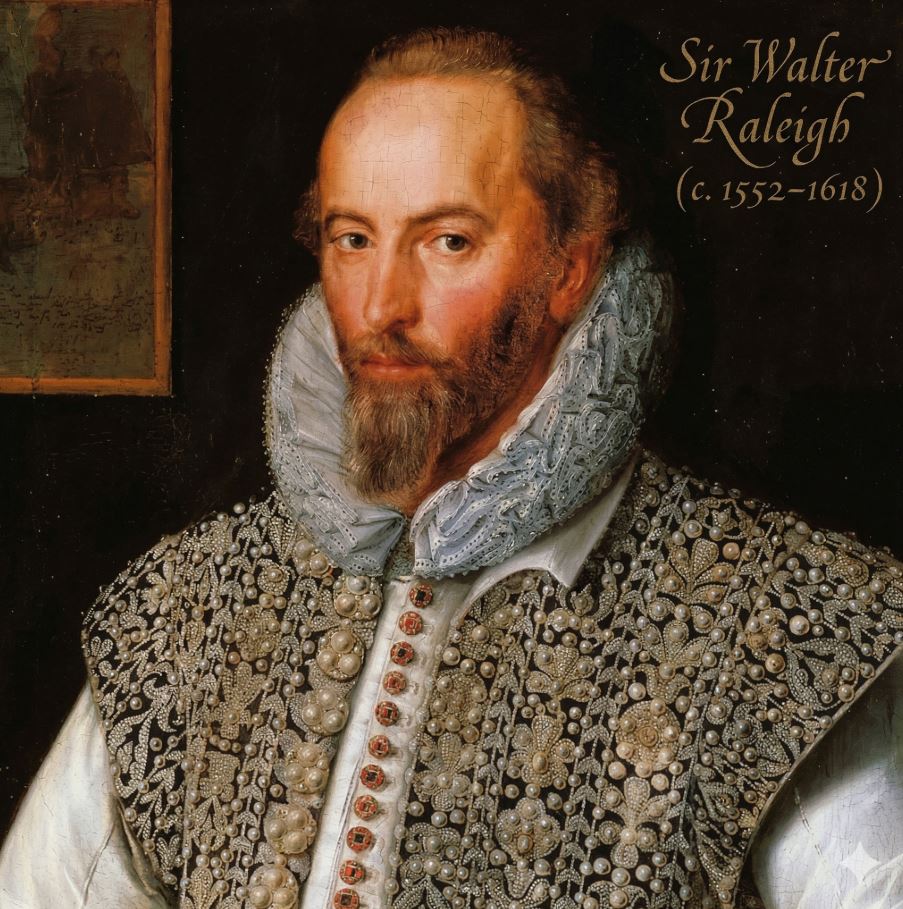
He was a poet, a privateer, a royal favourite, and a condemned traitor. Sir Walter Raleigh (c. 1552–1618) was the very embodiment of the English Renaissance—a man whose ambition pushed the boundaries of the known world, but whose arrogance and political missteps ultimately cost him his head.
Whether you know him as the man who supposedly laid his cloak over a puddle for Queen Elizabeth I, or the explorer who introduced tobacco to England, Raleigh’s life is a masterclass in the dangerous game of Tudor and Stuart politics. Here is a look at the spectacular rise and dramatic fall of one of history’s most captivating figures.
A Dashing Favourite at Court
Born into a well-connected, devoutly Protestant family in Devon, England, Raleigh cut his teeth as a soldier fighting in the French Wars of Religion and later in Ireland. However, it was his arrival at the royal court in 1580 that truly launched his career.
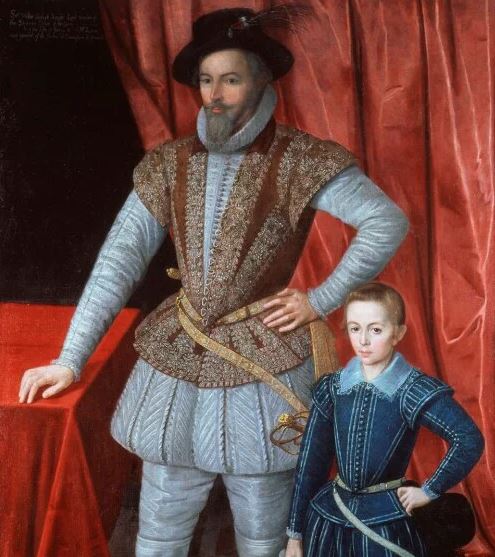
Tall, handsome, and impeccably dressed, Raleigh possessed a sharp wit and a talent for poetry that immediately caught the attention of Queen Elizabeth I. He quickly became one of her most trusted favorites. The Queen showered him with wealth, monopolies, and prestigious titles, including Captain of the Yeomen of the Guard.
While the famous legend of Raleigh throwing his expensive cloak over a muddy puddle for the Queen is likely a myth, it perfectly captures the theatrical charm and gallantry that he used to secure his place by her side.
The New World and the “Lost Colony”
Raleigh was a visionary when it came to English expansion. Though he is often credited with exploring North America himself, he actually orchestrated and financed these expeditions from afar, as the Queen refused to let her favorite courtier leave her side.
- Roanoke Island: Between 1584 and 1587, Raleigh sponsored attempts to establish the first English settlement in North America on Roanoke Island (in present-day North Carolina). The colony famously vanished without a trace, becoming the legendary “Lost Colony.”
- Potatoes and Tobacco: While he didn’t discover them, Raleigh played a massive role in popularizing tobacco smoking in the English court and is widely (though perhaps inaccurately) credited with introducing the potato to Britain and Ireland.
Love, Jealousy, and the Tower of London
Elizabeth I demanded absolute loyalty and devotion from her courtiers. In 1591, Raleigh made a fatal miscalculation: he secretly married Elizabeth “Bess” Throckmorton, one of the Queen’s own maids of honor.
When the Queen discovered the marriage and the birth of their child a year later, her legendary temper flared. She felt deeply betrayed and immediately imprisoned both Raleigh and his new wife in the Tower of London. Though Raleigh eventually bought his release, he permanently lost his undisputed status as the Queen’s favorite.
The Quest for El Dorado and a Grisly End
With his influence at court waning, Raleigh set his sights on South America. In 1595, he led an expedition to Guiana (modern-day Venezuela) in search of “El Dorado,” the mythical city of gold. He found no gold, but he published a wildly exaggerated account of his travels that cemented the El Dorado legend in the European imagination.
When Queen Elizabeth died in 1603, Raleigh’s fortunes took a dark turn. Her successor, King James I, actively disliked him. Raleigh was quickly accused of treason for allegedly plotting against the new king and was sentenced to death. James commuted the sentence to life imprisonment, and Raleigh spent the next 13 years living comfortably in the Tower of London, writing poetry and his famous book, The Historie of the World.
In 1616, James I released Raleigh for one final, desperate gamble: a second expedition to find El Dorado. The terms were strict—Raleigh was pardoned on the condition that he brought back gold and absolutely did not provoke the Spanish.
The expedition was a spectacular disaster. His men found no gold, Raleigh’s own son Walter was killed in a skirmish, and his troops attacked a Spanish outpost, directly violating the King’s orders. Upon his return to England, the Spanish ambassador demanded his head. King James I happily obliged, invoking Raleigh’s original 1603 death sentence.
On October 29, 1618, Raleigh was led to the executioner’s block at the Palace of Westminster. Ever the brave and theatrical courtier, he examined the executioner’s axe, running his finger along the blade, and remarked, “This is a sharp Medicine, but it is a Physician for all diseases and miseries.” When the executioner hesitated, Raleigh uttered his famous last words: “What dost thou fear? Strike, man, strike!”