
The Green Fairy’s Map: From Alpine Apothecaries to the Bars of New Orleans
The emerald spirit known as absinthe has lived several lives: an ancient cure, an artistic muse, an industrial scapegoat, and an outlawed phantom. Yet absinthe’s story is equally a story of geography. It is an odyssey charted across European mountain valleys, military frontiers, Parisian boulevards, and the humid, cocktail-obsessed corners of the American South.
As detailed in the documentary The History of Absinthe — The Drink Europe Tried to Erase, absinthe was forged through distinct locations before planting deep roots in New Orleans—a city that preserved its cocktail traditions during a 95-year federal ban.
1. Couvet & the Val-de-Travers, Switzerland: The Alpine Crucible
- The Origin: Long before absinthe entered Parisian cafes, wild wormwood (Artemisia absinthium) was revered across the Mediterranean as a bitter antiparasitic medicine [01:27]. In the early 1790s, amid the upheavals of the French Revolution, a French physician named Dr. Pierre Ordinaire fled across the border to Couvet, in Switzerland’s Val-de-Travers [04:17].
- The Distillation: In this narrow valley in the Jura Mountains, Ordinaire blended wormwood with green anise, sweet fennel, hyssop, and other herbs into a high-proof elixir [05:23]. When mixed with cold water, the emerald spirit turned cloudy and iridescent—a botanical reaction called the louche [05:59].
- Commercialization: The recipe was acquired by Major Daniel-Henri Dubied, whose daughter married Henri-Louis Pernod. In 1798, the family established their first commercial distillery in Couvet [06:45].
2. Pontarlier, France: The Industrial Capital of Absinthe
- Across the Frontier: In 1805, seeking to avoid cross-border trade tariffs into France, Henri-Louis Pernod moved operations just across the border to Pontarlier, founding Maison Pernod Fils [07:21].
- A Spirit Hub: What began as a modest 16-liter-a-day plant transformed over the 19th century into an industrial hub [07:36]. At its peak, Pontarlier hosted 28 absinthe distilleries, producing tens of thousands of liters daily and cementing the town as the global capital of absinthe production [07:52].
3. French Algeria: The Military Ration
- The Conquering Tonic: In the 1840s, French troops deployed in the Algerian campaigns received absinthe as an army ration to purify brackish water and ward off dysentery and malaria [08:07].
- Homecoming: Soldiers returned to metropolitan France with an acquired taste for the bitter aperitif, transforming a provincial medicine into a national habit [08:23].
4. Paris: L’Heure Verte and the Bohemian Muse
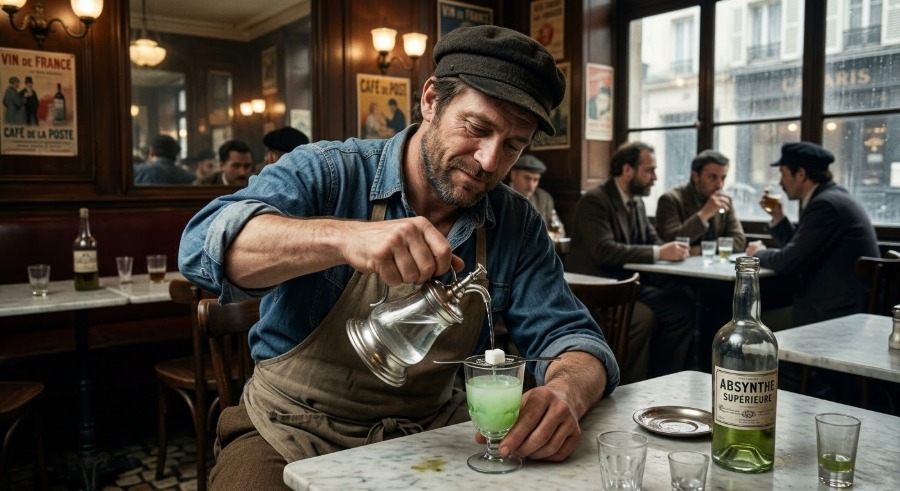
- The Green Hour: By the 1860s, Paris had institutionalized l’heure verte (the Green Hour) at 5:00 PM, when outdoor cafe terraces filled with patrons dripping ice water over slotted silver spoons and sugar cubes [09:02].
- The Bohemians: In Montmartre and the Latin Quarter, absinthe became the fuel of the avant-garde. Degas painted it (L’Absinthe), while Manet, Van Gogh, Toulouse-Lautrec, Verlaine, and Rimbaud adopted it as their creative talisman [10:21].
- The Great Wine Blight: Between the 1860s and 1890s, the phylloxera aphid devastated French vineyards [11:32]. As wine supplies plummeted and prices soared, distillers turned to inexpensive industrial grain and beet alcohol [12:06]. Absinthe rapidly shifted from a bourgeois and bohemian indulgence into an affordable, ubiquitous drink of France’s working class—skyrocketing from 700,000 liters consumed in 1874 to 36 million liters annually by 1910 [12:39].
5. Commugny, Switzerland: The Moral Panic
- The Catalyst: With surging consumption came moral panic. Temperance crusaders and recovering French vineyard lobbies weaponized flawed neurological studies by psychiatrist Valentin Magnan, which falsely claimed that wormwood’s compound, thujone, caused an incurable condition called “absinthism” [20:37].
- The Crime: On August 28, 1905, in the small Swiss village of Commugny, a laborer named Jean Lanfray murdered his family [00:00]. Though Lanfray had spent the day consuming massive volumes of wine, cognac, brandy, and liqueur alongside two glasses of absinthe, international headlines blamed the “Green Curse” exclusively [25:23].
- The Outlawing Wave: Commugny’s tragedy provoked sweeping constitutional bans: Switzerland enacted its national prohibition in 1910, followed by Belgium, the Netherlands, and eventually France in 1914–1915 [26:22].
6. New Orleans: America’s Sanctuary of the Green Fairy
While Europe criminalized the drink, absinthe had already established a distinct legacy in the United States—anchored firmly in the port of New Orleans.
- The Arrival: French trade ties brought absinthe to New Orleans by roughly 1840 [17:15]. Unlike other American cities, the French Quarter adopted the afternoon ritual of the louche with ease [17:23].
- Temples on Bourbon Street: In 1874, an establishment at the corner of Bourbon and Bienville streets opened its doors: The Old Absinthe House [17:39]. Featuring heavy brass-and-marble cold-water fountains, it became an institution where politicians, artists, and locals watched the spirit cloud in their glasses [17:46].
- Signature Cocktails:
- The Sazerac: Created and refined in New Orleans saloons, marrying rye whiskey, Peychaud’s Bitters, sugar, and an aromatic coating of absinthe inside the chilled glass [18:03]. It would later become the official cocktail of New Orleans [18:09].
- The Absinthe Frappé: Invented in the French Quarter (traditionally credited to Cayetano Ferrér at the Old Absinthe House in 1874), blending absinthe, anisette, and crushed ice into a frosted, refreshing drink suited for Louisiana’s subtropical climate [18:15].
7. The 95-Year Exile and the Crescent City Redemption
- The Federal Ban (1912): On July 25, 1912, the United States Department of Agriculture banned absinthe nationwide under the Pure Food and Drug Act, adopting European anti-thujone hysteria without conducting independent scientific testing [26:40].
- The Enduring Ban: When national Prohibition was repealed in 1933, absinthe was left off the list of legalized spirits. For decades, New Orleans bartenders preserved historic recipes by substituting pastis, Herbsaint, or Pernod anisette [28:03]. The ban endured for 95 years [28:39].
- The Science Prevails: Absinthe’s exoneration originated back in New Orleans. In the early 2000s, native New Orleans research chemist Ted Breaux acquired sealed, preserved bottles of 19th-century French and Swiss absinthe [28:54]. Using gas chromatography and mass spectrometry, Breaux proved that authentic pre-ban absinthe contained only trace amounts of thujone—well within modern safety limits and far below toxic levels [29:31].
- The Revival (2007): Armed with this data, Breaux petitioned the Alcohol and Tobacco Tax and Trade Bureau (TTB). On March 5, 2007, the U.S. government lifted the 95-year-old ban [30:15].
Today, historic establishments like the Old Absinthe House along with contemporary cocktail dens across the French Quarter, Marigny, and the Central Business District serve authentic absinthe drip rituals and original Sazeracs once again [33:04].