
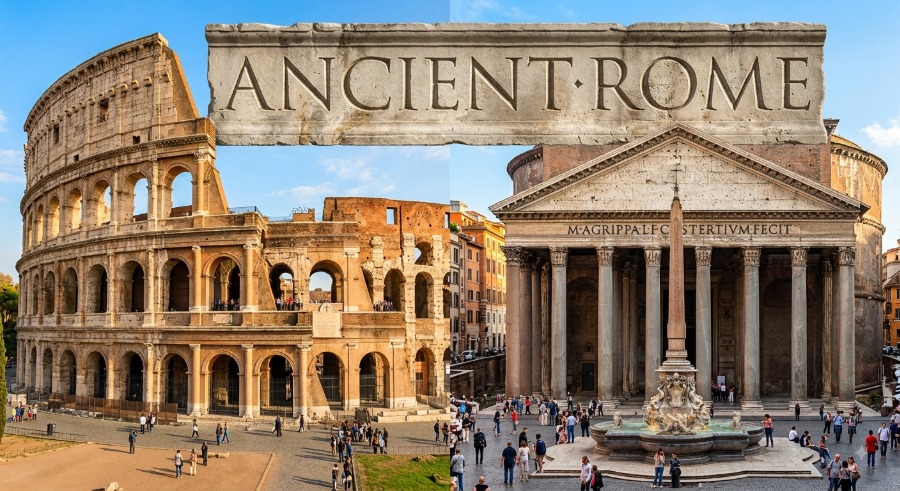
While both sit within walking distance in Rome’s historic core, they offer two distinct perspectives on Roman architecture: one built for mass public spectacle, the other for sacred endurance.
The Colosseum: Rome’s Arena of Spectacle
Commissioned around 70–72 AD under Emperor Vespasian and completed under Titus in 80 AD, the Flavian Amphitheatre could seat up to 65,000 spectators for gladiatorial games, hunts, and theatrical recreations.
- The Architecture: Built with travertine limestone, volcanic tuff, and concrete, it pioneered a freestanding elliptical design that used nested barrel vaults to funnel massive crowds efficiently.
- The Hypogeum: Beneath the wooden arena floor lay a two-level network of tunnels, cages, and mechanical lifts used to hoist gladiators and wild animals directly into the arena.
The Pantheon: The Unbroken Masterpiece
Completed around 126–128 AD under Emperor Hadrian on the site of Marcus Agrippa’s earlier temple, the Pantheon remains the best-preserved monument of ancient Rome. Consecrated as the Basilica of St. Mary and the Martyrs in the 7th century, it has remained in continuous use for nearly two millennia.
- The Dome: It holds the record as the world’s largest unreinforced concrete dome, spanning an exact 43.3-metre (142 ft) diameter and matching height.
- The Oculus: A 9-metre open skylight at the apex provides the interior’s primary illumination; rainwater drains through 22 discreet holes set into the concave marble floor.
Planning Your Visit
| Feature | The Colosseum | The Pantheon |
|---|---|---|
| Location | Piazza del Colosseo (Metro: Colosseo, Line B) | Piazza della Rotonda (Centro Storico) |
| Entry Fee | Paid (includes Roman Forum & Palatine Hill) | Paid standard admission (€5) |
| Booking | Pre-booking online is mandatory for timed slots | Pre-booking recommended, required on weekends |
| Key Highlight | Arena floor, top tiers & subterranean hypogeum | Unreinforced dome, oculus & Raphael’s tomb |
| Dress Code | Standard casual | Modest (shoulders and knees covered) |