
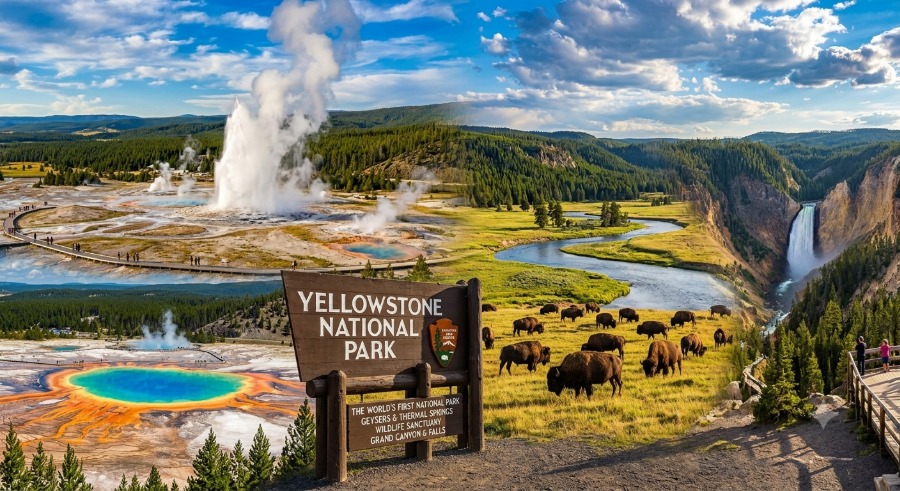
When President Ulysses S. Grant signed the Yellowstone National Park Protection Act into law on March 1, 1872, he established the world’s first national park and launched a global conservation movement. Encompassing nearly 3,500 square miles (over 2.2 million acres) across northwest Wyoming and edges of Montana and Idaho, Yellowstone remains one of North America’s most dynamic natural sanctuaries.
A Living Supervolcano and Hydrothermal Realm
At Yellowstone’s heart lies a dormant supervolcano whose massive caldera—spanning roughly 30 by 45 miles—was carved during catastrophic volcanic cycles over the last two million years. This volcanic hotspot drives the park’s subterranean plumbing, generating more than 10,000 thermal features:
- Geysers: Home to over 500 active geysers—more than half the planet’s total—including the predictable bursts of Old Faithful and the towering eruptions of Steamboat Geyser.
- Hot Springs: Features like Grand Prismatic Spring display vivid bands of orange, yellow, and deep turquoise created by heat-loving microorganisms known as thermophiles.
- Mudpots and Fumaroles: Acidic steam vents and bubbling mineral pools, such as the Artist Paint Pots, showcase ongoing chemical breakdown of subterranean rock.
America’s Serengeti
Yellowstone serves as the core of the 28,000-square-mile Greater Yellowstone Ecosystem, one of Earth’s last largely intact temperate ecosystems. It holds the largest concentration of wild mammals in the contiguous United States:
- Bison: Yellowstone is home to the only continuous, free-ranging wild bison herd in the country since prehistoric times.
- Apex Predators: Grizzly bears, black bears, and cougars roam the valleys alongside gray wolves, whose landmark reintroduction in 1995 revitalized the park’s trophic ecology.
- Ungulates: Tens of thousands of elk, along with moose, bighorn sheep, and pronghorn, navigate seasonal migration routes through the Lamar and Hayden valleys.
Canyons, Lakes, and Waterfalls
Beyond geothermal fields and wildlife corridors, the park’s topography features dramatic elevation changes:
- The Grand Canyon of the Yellowstone: A sheer, 20-mile canyon carved by the Yellowstone River, exposing brilliant yellow, pink, and iron-stained volcanic rock walls flanked by the 308-foot Lower Falls.
- Yellowstone Lake: One of the highest-elevation major freshwater lakes in North America, sitting at 7,733 feet above sea level with over 110 miles of shoreline.
- Mammoth Hot Springs: Towering travertine terraces formed by limestone-rich spring water depositing cascading mineral steps over millennia.
Preserving a Global Benchmark
Yellowstone has evolved from early military stewardship into a model of active modern conservation. Designated a UNESCO World Heritage Site in 1978, the park continues to balance high visitor volumes with wildlife protection, wildfire management, and scientific exploration of its delicate ecosystems.