For years, the Middle East was the world’s transit lounge—a reliable, glittering bridge between East and West.
Standing in the terminal at Heathrow, looking at the departures board, feels different this April. Since the conflict between the U.S. and Iran escalated into open war in late February, that bridge hasn’t just burned; it’s become one of the most expensive detours in aviation history.
As a frequent traveller, I’ve seen prices fluctuate, but what we are witnessing now is a “triple-threat” surge: fuel costs, rerouting premiums, and a massive supply crunch.
1. The “Tank” Surcharge
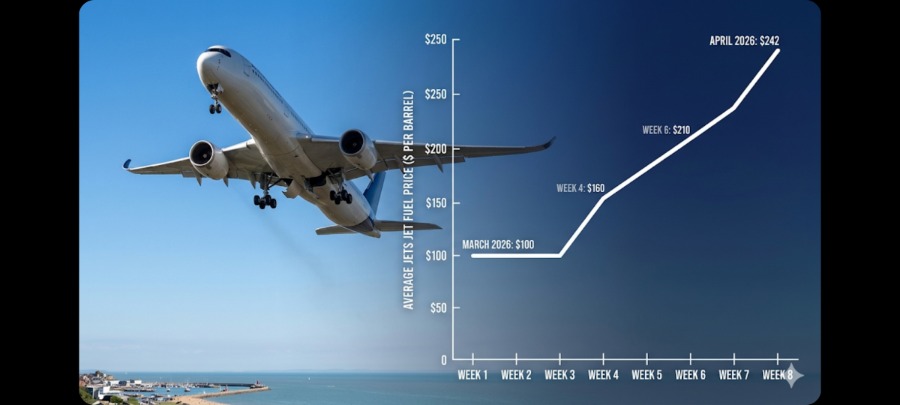
The most immediate hit to our wallets comes from the fuel pump. Since “Operation Epic Fury” and the subsequent blockades in the Strait of Hormuz began, global jet fuel prices haven’t just risen—they’ve doubled.
- The Math of the Ticket: At the start of the year, jet fuel sat around $99 per barrel. By early April, it peaked near $209.
- The Pass-Through: For us, this translates to “fuel supplements.” Even in economy, long-haul flights leaving Europe are now carrying an average surcharge of $104 per passenger.
2. The Great Detour
Flying from London to Bangkok used to be a straight shot over the Gulf. Now, looking at flight trackers, it looks like a game of Snake. With Iranian airspace closed and major hubs like Dubai, Doha, and Abu Dhabi operating at severely reduced capacity—or closing entirely during peak tensions—airlines are forced to take the long way around.
- Extra Time = Extra Money: Adding two to four hours to a flight doesn’t just annoy your knees; it burns thousands of gallons of extra fuel and requires additional crew hours.
- Capacity Collapse: Carriers like Lufthansa and Air France-KLM have cancelled thousands of flights simply because the fuel isn’t available or the routes are too costly to maintain.
3. The Price of “Getting Home”
If you were caught in the Middle East when the ceasefire wobbled last week, you felt the “rebooking sting.” I met a traveller in Oman who had to put a £2,000 ticket on a credit card just to get back to London—a flight that normally costs £215.
| Route | Pre-War Avg Price | Current “Scramble” Price |
|---|---|---|
| Dubai to London | £376 | £1,800+ |
| Abu Dhabi to Manchester | £280 | £850+ |
| Thailand to Europe | £500 | £1,000+ |
Tips for the “New Normal”
If you absolutely have to fly while the U.S. and Iran navigate these shaky April ceasefires, here is how the veteran travellers are pivoting:
- Avoid the Hubs: Look for routes that bypass the Middle East entirely. Trans-Pacific routes or flights via Central Asia/Africa are becoming the new “safe” (though still expensive) alternatives.
- Check the “Fuel Hedge”: European carriers often “hedge” (pre-buy) fuel, meaning they might absorb the cost longer than U.S. carriers like American Airlines, which recently reported a $4 billion hit to their fuel budget.
- Insurance is Mandatory: Don’t even think about booking without “Cancel For Any Reason” (CFAR) insurance. With airspace closing on a dime, a standard policy won’t always cover a war-related “operational change.”
The Bottom Line: We used to complain about a $50 baggage fee. Today, we’re just hoping the plane has enough fuel to take the long way home. The “Golden Age” of cheap long-haul transit is, for now, a casualty of war.