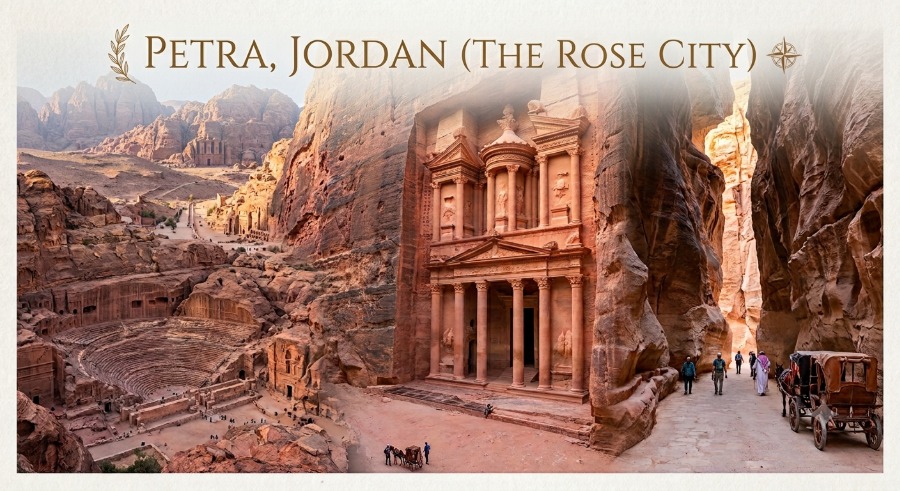
Carved directly into the vibrant sandstone cliffs of southern Jordan, Petra is one of the world’s most astonishing archaeological wonders.
Once the thriving commercial capital of the Nabataean Empire from roughly the 4th century BCE to 106 CE, this desert metropolis controlled the lucrative incense, spice, and silk trade routes connecting Arabia, Egypt, and the Mediterranean.
The Approach: Walking Through the Siq
The journey into Petra begins through the Siq, a dramatic 1.2-kilometer geological gorge flanked by sheer cliffs reaching up to 80 meters high. As you walk the winding path, you can spot remnant terracotta water conduits built into the rock walls—evidence of the sophisticated hydraulic engineering that allowed the Nabataeans to store flash-flood waters and thrive in an arid climate.
At the end of the narrow canyon, the canyon walls peel back to frame your first glimpse of Al-Khazneh (The Treasury). Carved out of pale pink and salmon-hued rock, its Hellenistic facade stands nearly 40 meters tall, an architectural statement designed to awe visiting trading caravans.
Key Highlights Beyond the Treasury
Most visitors stop at the Treasury, but the ancient city sprawls across roughly 264 square kilometers of canyons and plateaus.
- The Street of Facades & Theater: Beyond the Treasury lies an amphitheater cut directly into the hillside, capable of seating over 4,000 spectators, surrounded by intricate tomb entrances.
- The Royal Tombs: A dramatic sequence of monumental burial chambers set into the face of the Jabal al-Khubtha rock wall, featuring the Urn Tomb and the Silk Tomb, renowned for its swirling ribbons of pink, ochre, and white sandstone.
- The Colonnaded Street: The heart of civic life during Roman annexation, flanked by the ruins of the Great Temple and public markets.
- Ad-Deir (The Monastery): Petra’s largest carved monument, tucked high in the hills. Reaching it requires ascending roughly 800 stone steps, rewarding hikers with sweeping panoramic views over the Wadi Araba desert valley.
- The High Place of Sacrifice: A steep mountain trek leading to ancient altars and obelisks where Nabataean religious ceremonies took place.
Practical Visit Planner
| Detail | Recommendation |
|---|---|
| Ideal Duration | 2 full days (allows pacing without rushing the 15–20km of daily walking) |
| Base Town | Wadi Musa (hotels and restaurants sit within walking distance of the visitor center) |
| Best Time to Visit | Spring (March to May) or Autumn (September to November) to avoid extreme desert heat |
| Opening Hours | 6:00 AM daily; arriving at dawn avoids peak midday heat and crowds |
| Footwear & Gear | Sturdy hiking shoes with grip for sandstone dust, wide-brim hat, sun protection, and a refillable water pack |
Travel Tips & Etiquette
- The Jordan Pass: Purchase the Jordan Pass online before travel. It waives tourist visa fees and covers entry to Petra (1, 2, or 3-day options).
- Petra by Night: On select evenings, the Siq and Treasury plaza are illuminated by thousands of paper-bag candles accompanied by traditional Bedouin music and storytelling.
- Animal Welfare: Camels, donkeys, and carriages are common, but strict welfare guidelines now exist. Walking the trails is the most respectful and immersive way to experience the ruins.
Would you like a matching panoramic feature image created for this Petra guide, similar to the Kyoto layout?