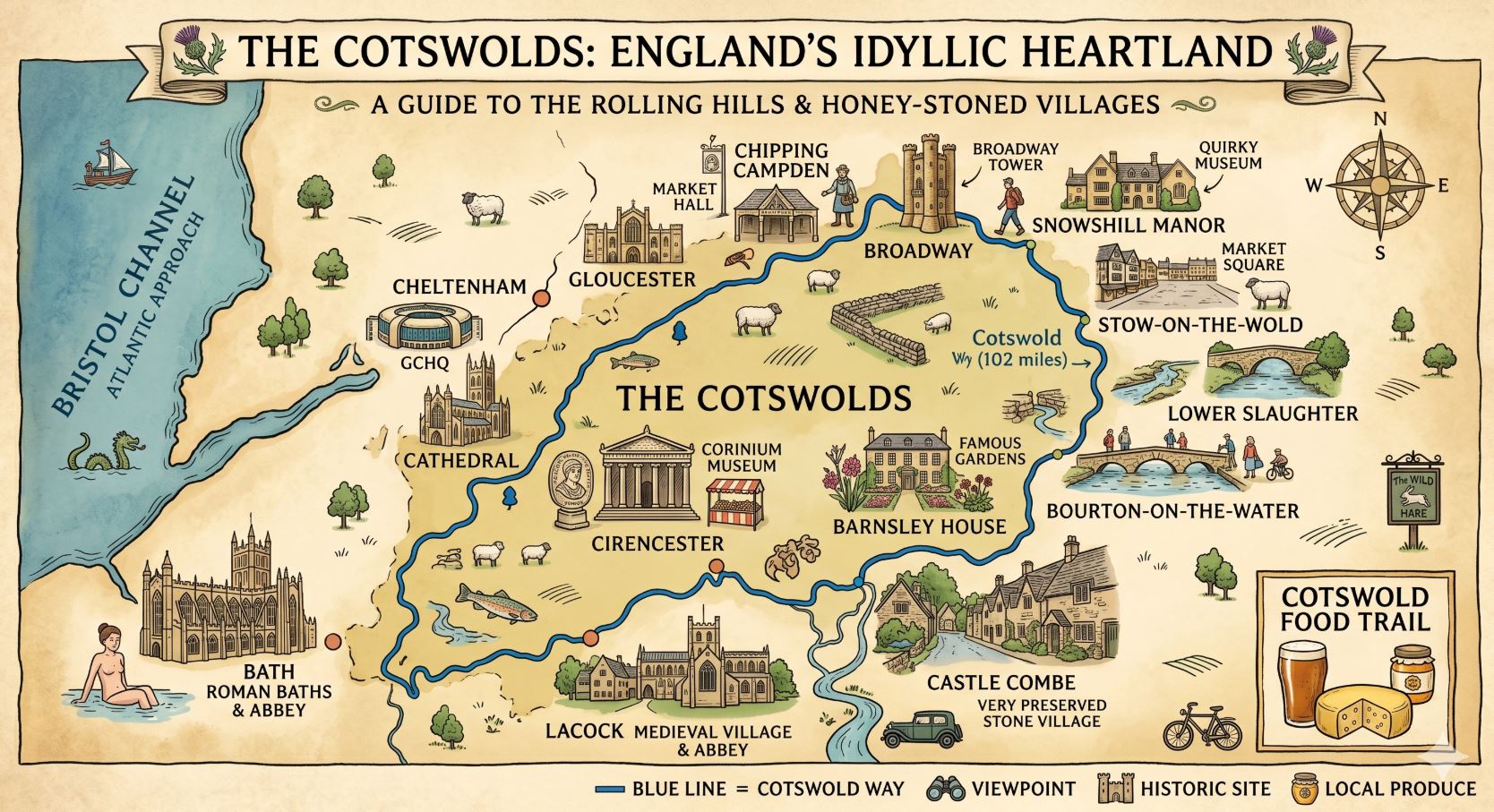
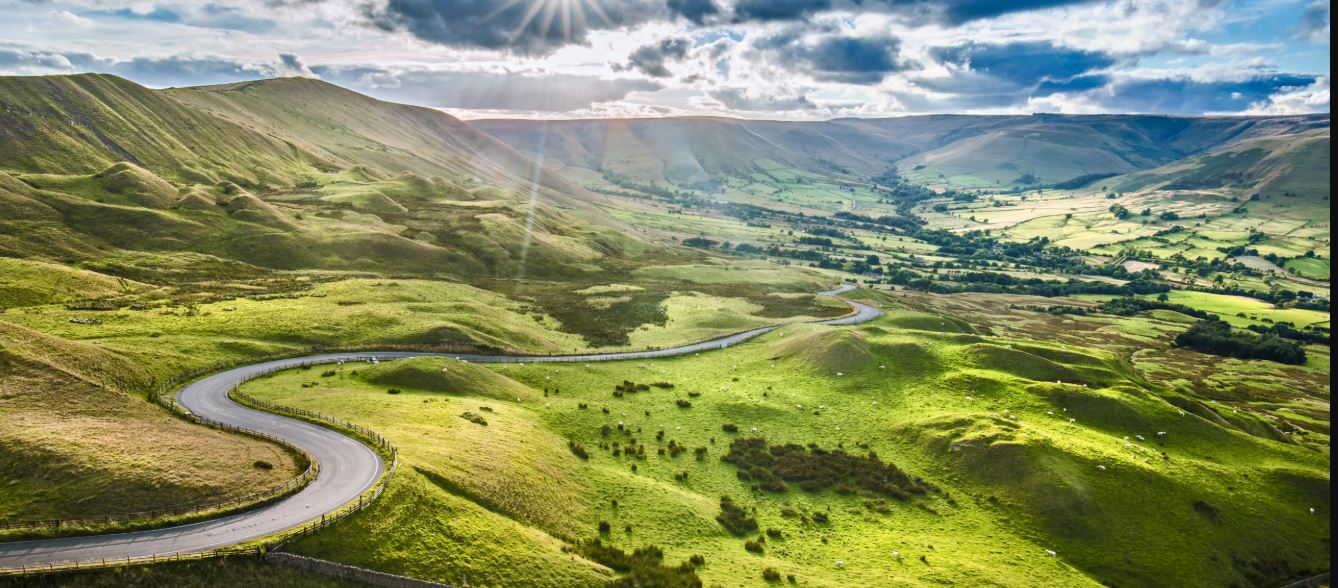
The Cotswolds is less of a single destination and more of a feeling: a sprawling, 800-square-mile tapestry of rolling hills (the “wolds”) and historic market towns carved entirely out of local, honey-coloured limestone. Spanning five counties, it is the ultimate destination for a slower, more deliberate pace of travel.
Whether you are plotting a weekend escape or a week-long road trip, this guide cuts through the tourist tracks to show you how to experience the true soul of the region.
📍 Navigating the Regions: North vs. South
The Cotswolds changes personality depending on where you draw the line. Because of the local geology, even the stone changes colour—shifting from a deep, warm iron-orange in the north to a pale, elegant cream in the south.
The High & Historic North
This is the classic, postcard-perfect Cotswolds. Expect steep escarpments, expansive views, and bustling historic market towns built on the medieval wool trade.
Stow-on-the-Wold: The highest town in the region, centered around a vast medieval market square. Don’t miss the north door of St Edward’s Church, famously framed by two ancient, looming yew trees.
Chipping Campden: The spiritual home of the Cotswolds Arts and Crafts movement. It boasts a beautifully preserved, wide High Street and a striking 17th-century covered market hall.
Bourton-on-the-Water: Nicknamed the “Venice of the Cotswolds” due to the low, elegant stone bridges arching over the shallow River Windrush. It is incredibly beautiful but gets highly congested in summer—visit early in the morning to enjoy the peace.
The Sleepy, Cinematic South
As you move south toward Wiltshire and Somerset, the valleys deepen, the crowds thin, and the landscape feels increasingly untouched by the modern world.
Castle Combe: Frequently named the prettiest village in England, this completely preserved gem looks exactly as it did in the 1600s. Walk down the main street to the bridge over the Bybrook river for a view that has framed dozens of period dramas.
Lacock: Owned almost entirely by the National Trust, this village has no overhead power lines or yellow road markings, making it a living time capsule (and a favorite filming location for Harry Potter and Downton Abbey).
🥾 Secret Escapes: Avoiding the Crowds
If you want to dodge the tour buses and experience the quiet, rural magic of the area, you only need to step slightly off the beaten path.
The Slaughters Walk
Instead of driving, park in Lower Slaughter—frequently home to “the most romantic street in Britain”—and take the peaceful, 1.5-mile riverside footpath to Upper Slaughter. It is a gentle, flat walk along the River Eye that takes you past old water mills, wild meadows, and grazing sheep, capturing the quintessential English countryside.
Cleeve Hill & The Cotswold Way
For panoramic vistas, bypass the popular Broadway Tower and head to Cleeve Hill. As the highest point in the Cotswolds ($330\text{ meters}$), it offers sweeping, uninterrupted views across the Vale of Evesham all the way to the Malvern Hills and Wales. It is a spectacular section of the 102-mile Cotswold Way National Trail.
🍽️ The Cotswold Larder: Where to Eat & Drink
The region’s rich farming heritage means “farm-to-fork” isn’t a marketing buzzword here—it’s a standard.
The Classic Pub: Seek out historic coaching inns with roaring log fires and low oak beams. The Porch House in Stow-on-the-Wold (reputed to date back to 947 AD) offers exceptional, elevated pub fare alongside great local ales.
The Foodie Hub: For something contemporary, visit the iconic Daylesford Organic Farm near Kingham. It’s a massive, beautifully designed estate featuring an organic farm shop, wellness space, and a fantastic seasonal restaurant.
The Local Treat: You cannot leave without experiencing a traditional afternoon cream tea. Drop into a village bakery—like the Bakery on the Water in Bourton—for warm, freshly baked scones topped with clotted cream and strawberry jam.
🚗 Practicalities & Planning
Detail
Recommendation
Best Time to Visit
Spring (May) for blooming cottage gardens and lambs in the fields, or Autumn (October) when copper and gold leaves frame the golden stone.
Getting Around
While some towns have train links (like Moreton-in-Marsh), a car is highly recommended to explore the quiet country lanes and isolated hamlets.
How Long to Stay
3 days is perfect for a highlights tour, but a full week allows you to slow down and truly absorb the pace of rural life.
A Note on Etiquette: Many of these picture-perfect locations are living, working villages. While it’s tempting to snap photos of every gorgeous cottage, remember to respect the privacy of the locals who call these historic buildings home.
Map Directory & Regional Key
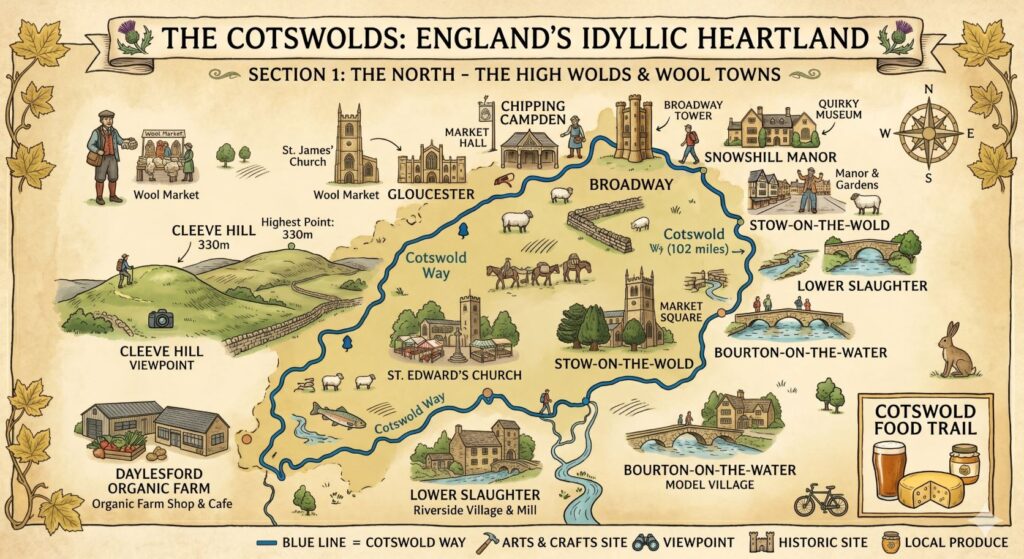
1. The North (Deep Golden/Iron-Orange Stone)
Chipping Campden: The northern gateway; home to the historic 17th-century Market Hall and the start of the Cotswold Way.
Broadway: Famous for its wide, picture-postcard High Street and independent boutiques.
Stow-on-the-Wold: The highest town in the region, centered around a sprawling medieval market square.
Bourton-on-the-Water: Built right over the low bridges of the shallow River Windrush.
The Slaughters (Upper & Lower): Just a stone’s throw from Bourton, offering a quiet, idyllic 1.5-mile riverside footpath connection.
Daylesford Organic: Located near Kingham; an estate featuring a renowned farm shop and seasonal dining.
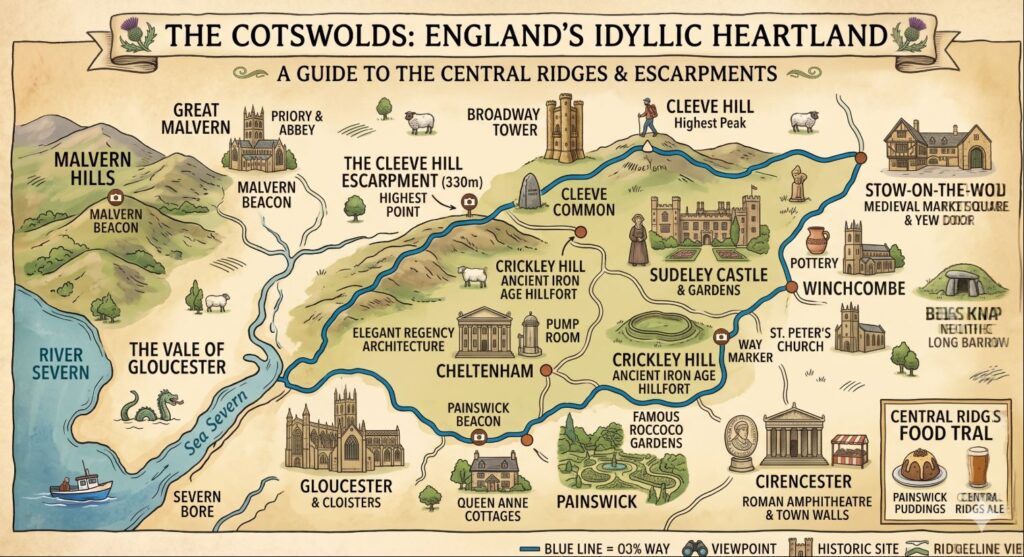
2. The Central Ridges
Cleeve Hill: The highest point in the Cotswolds ($330\text{m}$), situated just outside Cheltenham, offering panoramic views across the Vale of Evesham.
Cirencester: Historically known as Corinium Dobunnorum, this vibrant market town serves as the traditional “Capital of the Cotswolds.”
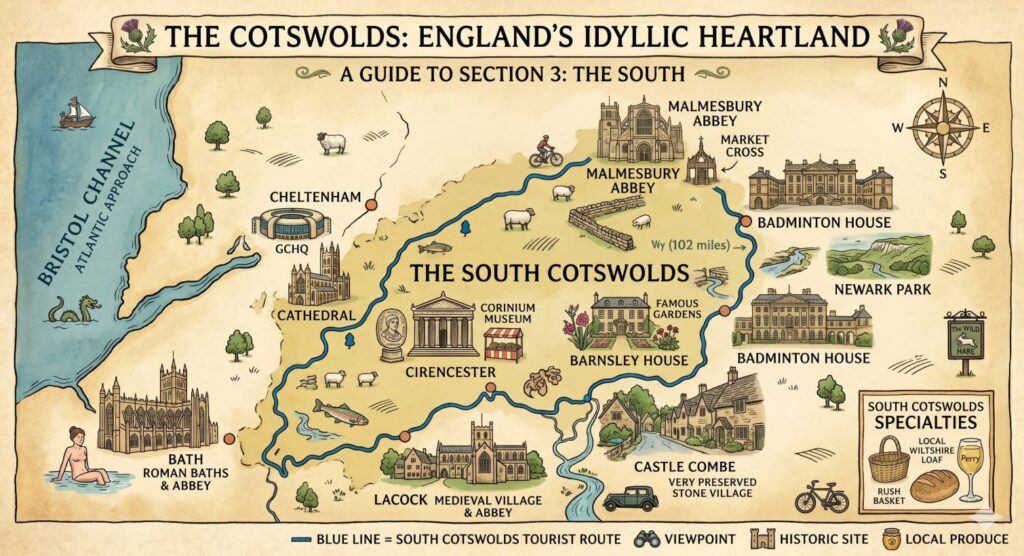
3. The South (Pale Cream/White Stone)
Castle Combe: A completely preserved Wiltshire valley village that looks virtually unchanged since the 17th century.
Lacock: A living time capsule village and abbey completely managed by the National Trust, located on the southern fringes.